Private & Convenient Collection
Collect your specimen in the privacy of your home. Orders arrive and return in plain, unmarked outer packaging to protect your confidentiality.
Laboratory-supported screening for specific infections from home. One kit provides confidential collection and clear reporting to help guide your sexual health discussions.
Take the guesswork out of routine screening with convenient at-home collection.
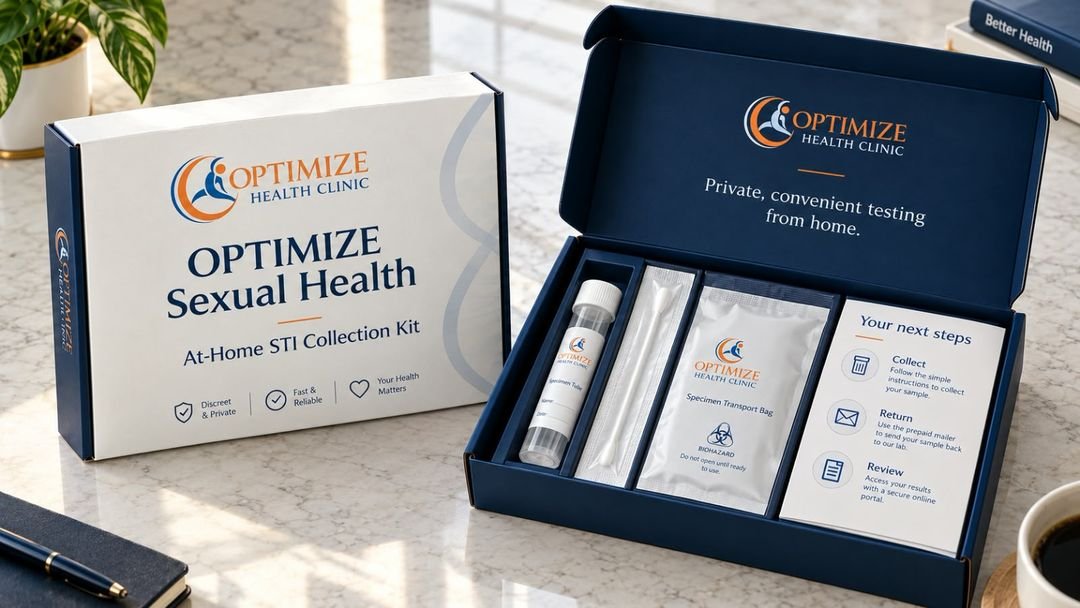
At-Home STI Collection Kit
Kit, Lab Processing & Digital Report Included
Clear physician-guided follow-up pathways
Private collection, accredited lab analysis and secure digital results.
Targeted laboratory screening designed for privacy, clinical clarity, and timely care.
Many common infections show no early symptoms. Optimize Sexual Health provides access to laboratory-supported screening from home, giving you the facts you need to protect your health and your partner’s.
Order Your Kit — $99
Collect your specimen in the privacy of your home. Orders arrive and return in plain, unmarked outer packaging to protect your confidentiality.
Samples are processed by an accredited clinical laboratory using validated assays specifically calibrated for the infections listed in your panel.
Receive straightforward results through a secure portal, paired with clinical guidance and next steps if your findings indicate follow-up care is needed.
Specific infections analyzed in this collection panel using laboratory-validated assays.
One of the most common bacterial sexually transmitted infections. It often causes no noticeable symptoms, which is why routine screening matters.
The bacterium that causes gonorrhea. Detecting it supports timely clinical discussions and appropriate treatment.
A common parasitic infection that can affect people of any sex and is frequently symptom-free.
A sexually transmitted bacterium linked to urethritis and cervicitis, often missed by routine panels.
A bacterium that can be found in the genital tract; its clinical relevance is interpreted together with symptoms and other findings.
HSV-1, traditionally associated with oral herpes, is also a frequent cause of genital herpes.
HSV-2, the type most often associated with recurrent genital herpes.
The bacterium that causes syphilis. Early detection allows timely follow-up and treatment.
The bacterium that causes chancroid, an infection that can produce painful genital ulcers.
Ureaplasma species that can be present in the genital tract; results are interpreted alongside symptoms by a clinician.
A Ureaplasma species reported separately in this panel; it may be associated with urethritis in some people.
A bacterium commonly associated with bacterial vaginosis (BV) when vaginal flora is out of balance.
Formerly known as Atopobium vaginae; another organism frequently associated with bacterial vaginosis.
A yeast species that can cause vaginal yeast infections and is naturally less responsive to some common antifungals.
Group B Streptococcus (GBS), a bacterium that is often carried without symptoms and is relevant in some clinical situations, such as pregnancy.
Clear instructions based on supported home-collection methods (such as lab-approved urine collection or targeted swabs). Results reflect only the specific pathogens included in this panel.
One of the most common bacterial sexually transmitted infections. It often causes no noticeable symptoms, which is why routine screening matters.
Optimize Sexual Health — At-Home STI Collection Kit.
Clear physician-guided follow-up pathways